Analysis: Fresh food pushes Rwanda's inflation to 19.5% ahead of the 25 November rate decision
4 min read
 Analysis
Urban inflation has risen every month since May and is now more than double the top of the National Bank of Rwanda's 2–8% target range. What the October figures show, how they compare with Kenya, Uganda and Tanzania, and what businesses should watch before the next policy meeting.
Consumer prices in Rwanda's towns were 19.5% higher in October 2026 than a year earlier, the National Institute of Statistics of Rwanda (NISR) reported on 10 November, up from 17.2% in September. Prices rose 3.3% in the month alone. Urban inflation is the headline measure the National Bank of Rwanda (BNR) uses for monetary policy. In rural areas, prices were 31.3% higher than a year earlier, and the national index rose 26.5%.
The rise has been steady. Urban inflation was 7.1% in October 2025, 8.9% in January 2026 and 13.0% in April, then went up each month from May: 13.6% in June, 14.5% in July, 15.7% in August, 17.2% in September and 19.5% in October. The average of the twelve months to October was 12.5%. The ten monthly readings for 2026 so far average about 13.4% (InvestRwanda.com calculation from the NISR table), already above the BNR's August projection of 13.1% for the whole of 2026, before the November and December figures are in.
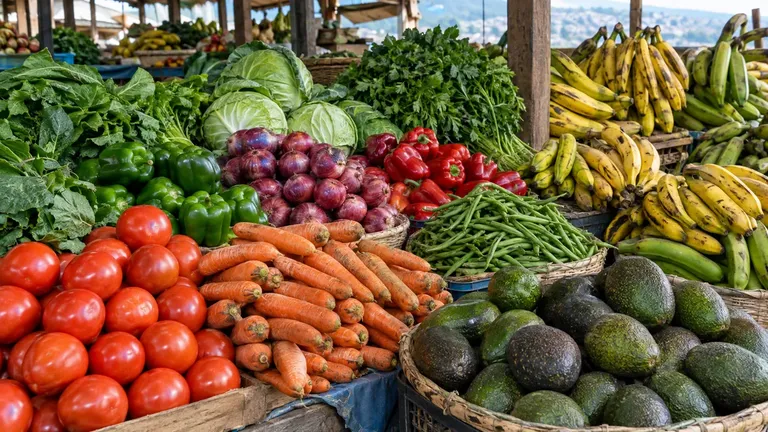
The October jump came mainly from food. Food and non-alcoholic beverages, 27% of the urban basket, were up 28.9% on a year earlier and 7.8% on September. Vegetables rose 56.4% over the year and 16.5% in the month. NISR's "fresh products" group was 39.9% higher than a year earlier. Energy prices were 36.3% higher than in October 2025 but almost flat in the month (+0.1%), and transport costs were up 22.4%. Underlying inflation, which excludes fresh products and energy, was 11.5%, with a monthly rise of 0.8%. Prices of locally produced goods rose 22.8% over the year, against 9.5% for imported goods, which suggests that the pressure is now coming mainly from domestic supply rather than from the exchange rate.
Costs for producers point in the same direction. NISR's producer price index for September 2026 was 21.5% higher than a year earlier, with prices for goods sold locally up 22.2% and export prices up 17.3%.
Policy has tightened, but less than inflation has risen. At its meeting on 26 August the BNR raised its central bank rate by 50 basis points to 8.75%, a cumulative 175 basis points since November 2025. It projected inflation at 13.1% in 2026 and 7.9% in 2027, returning to the 2–8% target range in the second half of 2027, and named the El Niño weather pattern and Middle East tensions as the main upside risks. In its annual report published on 6 November, the bank said inflation averaged 9.2% in the 2025/26 fiscal year, while real GDP grew 10.6% and the franc lost 2.28% against the US dollar, according to Xinhua's account of the report.
Rwanda is now well out of line with its neighbours. According to the comparison table published by Tanzania's National Bureau of Statistics, October inflation was 7.3% in Kenya (up from 6.8%), 5.8% in Uganda (up from 4.6%) and 4.2% in mainland Tanzania (down from 4.3%). All three have been rising since early 2026, mostly on fuel and food, but none is near Rwanda's level. The table does not include Burundi. The baskets differ: Rwanda's headline figure covers urban areas only, while Kenya and Tanzania publish national figures.
For companies, the figures matter in several ways. Businesses that sell to households face customers whose food bills have risen sharply. Restaurant and hotel prices rose 20.6% over the year, so hospitality operators are passing on part of their own food and energy costs. Firms that buy local farm produce as an input, such as food processors, face the steepest cost increases; the gap between local (22.8%) and imported (9.5%) inflation also shifts the relative cost of local and imported inputs. Fixed-price contracts in Rwandan francs, including leases and supply agreements, lose real value faster when inflation is this high.
For borrowers, the BNR's October Monetary Policy and Financial Stability Statement noted that retail interest rates had not yet followed the policy rate: the average bank lending rate was 15.78% in the first half of 2026 and the average deposit rate 9.48%. With urban inflation at 19.5%, both are below the current inflation rate. Credit to the private sector grew 12.1% in the first half, and the banks' non-performing loan ratio rose from 2.6% to 3.0% between June 2025 and June 2026. For holders of franc-denominated assets, the main question is how far and how fast the BNR responds.
What to watch next: the BNR's Monetary Policy Committee and Financial Stability Committee will present their decisions at a press conference on 25 November 2026, according to the bank's event calendar. The key points will be whether the bank raises the rate again and by how much, and how it revises its 13.1% forecast for 2026 and its 7.9% forecast for 2027. NISR's November CPI will show whether the fresh-food spike in October starts to ease, which depends largely on the coming harvests. Underlying inflation (11.5% in October) is the measure to watch for signs that high food prices are spreading to other goods and services. More on the central bank and its tools is in our guide to the National Bank of Rwanda.
Sources
- NISR: Consumer Price Index (CPI) – October 2026 (10 November 2026)
- NISR: Producer Price Index (PPI) – September 2026 (31 October 2026)
- National Bank of Rwanda: Monetary Policy Committee press release (26 August 2026)
- National Bank of Rwanda: Monetary Policy and Financial Stability Statement (October 2026)
- National Bureau of Statistics, Tanzania: Inflation rates for some neighbouring countries, October 2026 (9 November 2026)
- Xinhua via The Star: Rwanda's economy maintains strong momentum in 2025/2026: central bank (7 November 2026)