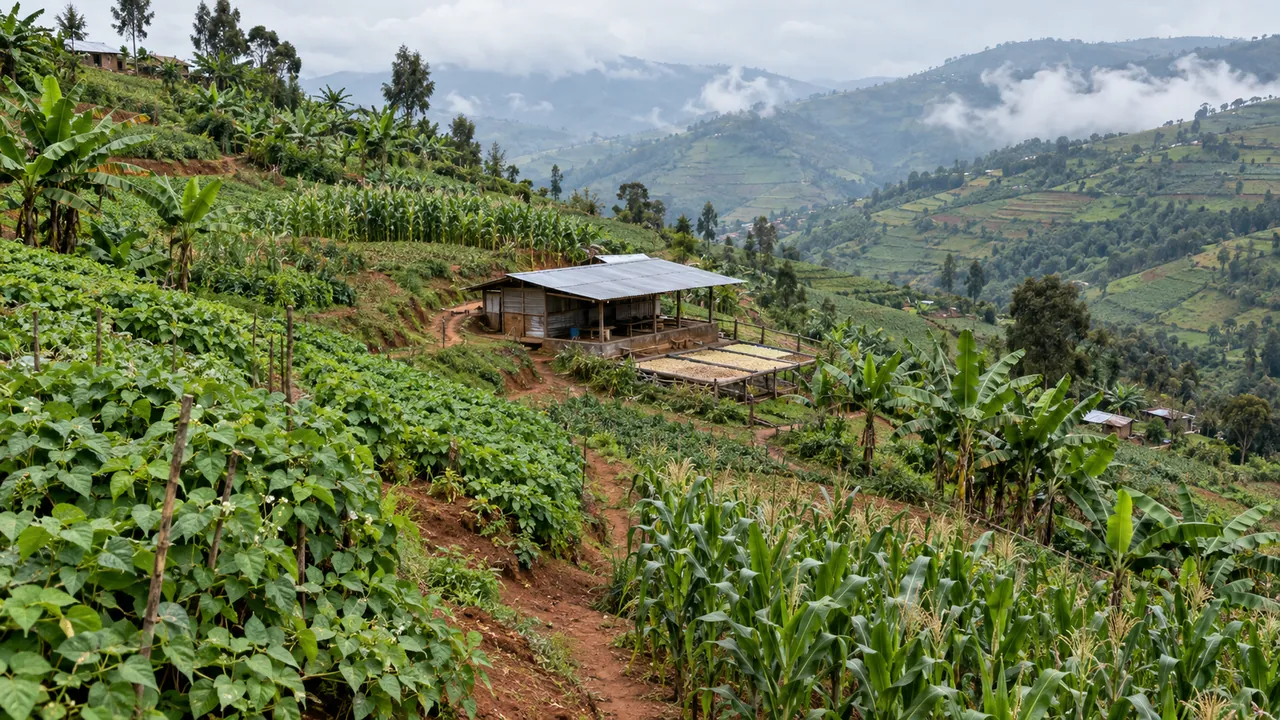
Agriculture and Agro-Processing in Rwanda
The sector in figures
| Activity | Value added 2025, RWF billion | Share of GDP |
|---|---|---|
| Food crops | 2,514 | 10.7% |
| Export crops (coffee, tea and others) | 567 | 2.4% |
| Livestock and livestock products | 757 | 3.2% |
| Forestry | 843 | 3.6% |
| Fishing | 66 | 0.3% |
| Agriculture, forestry and fishing | 4,748 | 20.3% |
In 2025 food crops grew 3% and export crops 32%, led by a 60% jump in coffee production. Growth slowed to 4% in the second quarter of 2026.
The PSTA5 plan, 2024–2029
The Fifth Strategic Plan for Agriculture Transformation (PSTA5) is the farm chapter of the national strategy NST2. It is costed at RWF 6,622.6 billion (about USD 5.1 billion) over five years and expects much of that to come from private investment.
- Agricultural growth of more than 6% a year.
- Irrigated land up from 74,375 ha to 132,171 ha.
- Milk output up from about 1.1 million tonnes to more than 1.3 million tonnes a year.
- Agricultural exports up from USD 893.2 million in 2024/25 to USD 1.54 billion by 2028/29.
Irrigation potential
A 2026 national assessment by the Ministry of Agriculture and FAO mapped 610,595 ha of potentially irrigable land across all 30 districts, or 386,381 ha net. Of that, 102,609 ha is classed as ready for immediate investment. Only 74,375 ha had been developed for irrigation by 2025.
Agro-processing
Food manufacturing (RWF 477 billion) and beverages and tobacco (RWF 579 billion) together made up more than half of manufacturing value added in 2025, and food processing grew 9%. Much of the raw material still leaves the country unprocessed or is imported.
RDB lists these openings for investors:
- Food processing of staples such as beans, rice, maize and potatoes.
- Dairy (UHT milk, yoghurt, cheese and butter), poultry and meat processing.
- Coffee washing and roasting.
- Mechanisation and irrigation equipment.
- Cold chain and distribution for export produce.
Before you invest
Most farms are small family plots, so many processors source through cooperatives or contract farming rather than buying land. Agricultural investments can qualify for an RDB investment certificate and the incentives in the investment code; check the current list before you plan on them.
Frequently Asked Questions
How large is agriculture in Rwanda’s economy?
Farming, forestry and fishing produced 20.3% of GDP in 2025 and grew 7%.
What is PSTA5?
The Fifth Strategic Plan for Agriculture Transformation, for 2024–2029. It aims for growth above 6% a year and almost twice as much irrigated land, and is costed at RWF 6,622.6 billion.
How much land could be irrigated?
A 2026 assessment mapped 610,595 ha of potentially irrigable land, or 386,381 ha net. Of that, 102,609 ha is ready for immediate investment. Only 74,375 ha had been developed by 2025.
How big is food processing?
Food manufacturing and beverages and tobacco made up more than half of manufacturing value added in 2025. Food processing grew 9%.
Sources
- National Institute of Statistics of Rwanda: GDP national accounts, second quarter of 2026, tables
- National Institute of Statistics of Rwanda: GDP national accounts 2025
- National Agricultural Export Development Board: Agricultural exports surpass USD 1 billion
- Ministry of Agriculture and Animal Resources: Rwanda’s agriculture sector transformation over the last 32 years
- Ministry of Agriculture and Animal Resources: Rwanda launches the fifth Strategic Plan for Agriculture Transformation
- FAO: Rwanda and FAO map a path from irrigation potential to investment
- Rwanda Development Board: Agriculture investment opportunities
Figures checked 9 November 2026. Prepared by InvestRwanda.com for general information. It is not investment, tax or legal advice; please confirm details with a qualified adviser before acting.