At the Rwanda Mining Association's general assembly, miners said banks have no loan products for the sector, and NCBA Bank Rwanda announced equipment financing. Mineral export receipts nearly tripled in the first half of 2026, but mining does not appear among the sectors that receive most bank credit.
At its general assembly on 20 November, the Rwanda Mining Association (RMA) said access to bank finance is the main obstacle to reaching the government's target of USD 2.2 billion in annual mineral exports by 2029, up from USD 1.1 billion in 2023. According to The New Times, RMA chairperson Innocent Kagenga said no financial institutions had been lending to mining companies, and that the association, the Ministry of Finance and Economic Planning, the Rwanda Mines, Petroleum and Gas Board and banks have met to discuss loan products for the sector. NCBA Bank Rwanda announced it would offer specialised financing for equipment, machinery and expansion, drawing on Nedbank Group of South Africa, which completed the purchase of a 66% stake in NCBA Group in October 2026.
The export figures show why the question matters now. The New Times reports that mineral exports rose from USD 373 million in 2017 to USD 1.75 billion in 2024. The National Bank of Rwanda (BNR) says mineral export receipts rose by 181.7% to USD 402.1 million in the first half of 2026, from USD 142.8 million a year earlier, mainly because of international prices; this figure is part of merchandise exports, which BNR reports excluding gold. Mining and quarrying output grew by 22.6% in the first half of 2026, after 16.7% in 2025. Our analysis of the third-quarter trade figures covers the more recent monthly data.
Bank credit has not followed on the same scale. New loans by banks rose by 44.3% to FRW 1.7 trillion in the first half of 2026, according to BNR's October Monetary Policy and Financial Stability Statement, and went mainly to trade (30.2%), households (27%), construction (12.7%), manufacturing (12.4%), transport (6.4%) and agriculture (3.3%). Mining is not listed separately. In BNR's Annual Financial Stability Report for June 2026, mining is also absent from the seven top-financed sectors, the smallest of which, agriculture, holds 3.9% of total loans. KT Press reported in August that mining credit increased in the first half of 2026 after almost no financing a year earlier, and that banks had been cautious because the sector needs specialised risk assessment and some lenders had bad loans in it. BNR Governor Soraya Hakuziyaremye said then that banks are likely to fund mining more as they build capacity.
The pattern is similar elsewhere in the EAC. In Uganda, mining and quarrying held 1.1% of private sector credit in the three months to August 2026, according to the Bank of Uganda, at an average shilling lending rate of 16.0%. Tanzania has moved faster from a low base: the Bank of Tanzania reported that credit to mining and quarrying grew by 78.4% in the year to March 2026, the highest of any sector, and linked this to government initiatives to improve financing for artisanal and small-scale miners. Comparable sector shares for Kenya and Burundi were not available in the sources read for this article.
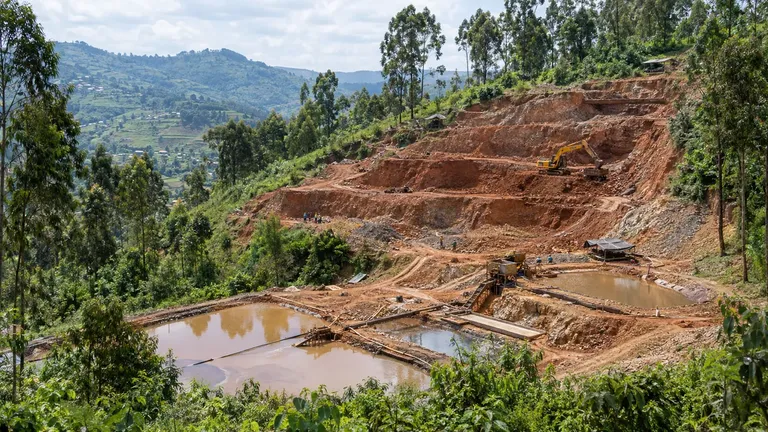
What it means for companies and investors: the RMA counts about 200 licensed mining companies and around 50 processing and smelting companies. Most rely on their own funds, Mr Kagenga said. For banks and leasing companies, the opening is equipment and asset finance, where the machine itself serves as collateral, which is how NCBA describes its approach. Rubavu Exploitation and Trading Company, a tungsten and tantalum producer, told the meeting it produces 10 to 15 tonnes of minerals a month and aims for 25 tonnes within three years, without bank finance so far. Officials also point to processing: Rwanda has gold and tantalum refineries and a tin smelter, and the Mines Board sees scope for lithium and tungsten refining and gemstone cutting. The risks are the ones banks cite: price swings, which drove much of the 2026 rise in receipts, a history of bad loans in the sector, and BNR's warning that mining is among the sectors exposed to commodity price volatility and weaker external demand. The government also aims to raise extraction efficiency from about 40% to 80% through mechanisation, which would need capital.
What to watch next: whether the loan products discussed with MINECOFIN and the Mines Board are launched, and by which banks besides NCBA; BNR's Monetary Policy and Financial Stability Committee statements on 25 November, which may update sector lending figures; and the Private Sector Federation's plan to work with the RMA in 2027 to identify processing projects and connect investors with financing partners. The PSF expects mineral exports to grow by 46% in the 2025/26 financial year, a forecast that the full-year trade data will test.
 Analysis